
For my English Composition class, my assignment was to write a two-paged descriptive essay about anything. I decided to write about my experience Monday while being fireman for the entire day. The essay quickly became 4.5pages(double-spaced) and I was only far enough along to use the blower! Mike McWilliams was my teacher/helper for the day, but for the sake of simplicity the essay is written in first person.
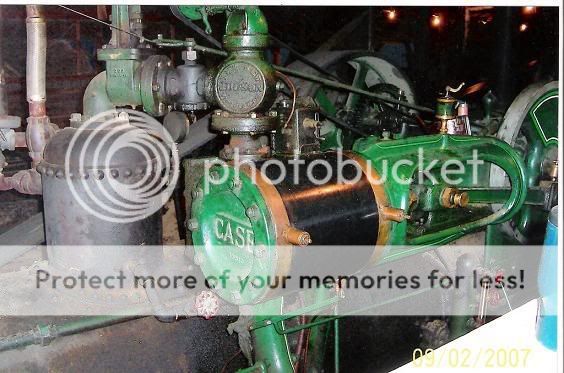
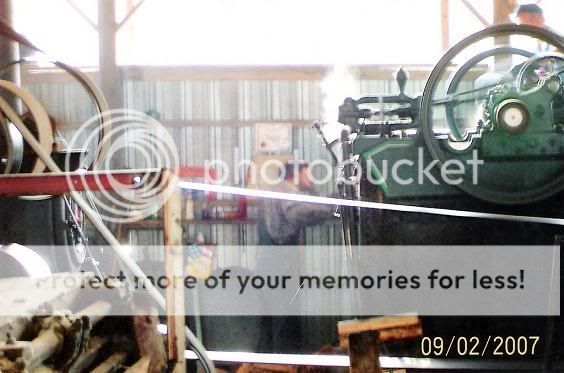
Here are some pictures to go with the story; for those who have not seen the engine.(I say 'not seen' because it's hard to forget )
)
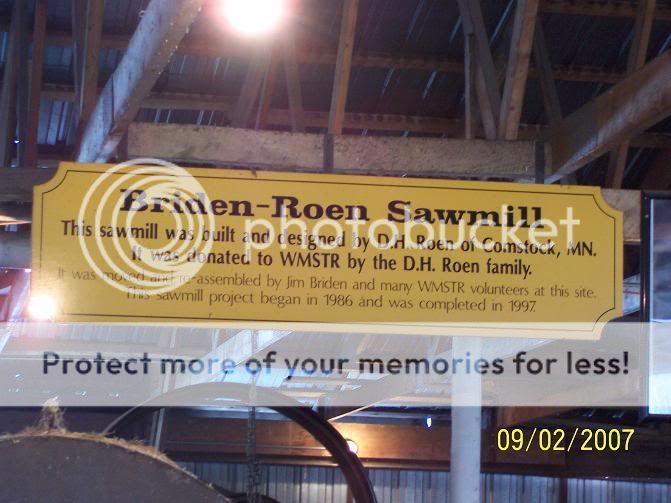
The workday in the steam-powered Briden and Roen Sawmill starts long before the sun comes out to announce the start of its day. Boiler operators like myself trickle into the sawmill under street lamps, anxious to begin another day in the antique sawmill that we call home for the four days of the Western Minnesota Steam Thresher's Reunion. Our foremost task is the cleaning and operating of the horizontal, cylindrical-shaped steam boilers that form the heart and soul of the mill. With boilers, though, cleaning always comes before operating.
The first early morning task for any fireman is to 'punch the flues' as it is called. Inside the both boilers, there are nearly 80 tubes that carry the fire over 15 feet through water before steam drives it out the stubby, partially rusted smoke stack. After a day of firing, each of those flues have a thin, black coat of dusty soot lining them from the firebox to the smoke box. My job was to use an unwieldy, long steel pole; longer than the flues, with a radial-shaped scraper on one end designed to carry all of the soot out to the smoke box.
The smoke box is not exactly a box at all, it is just an empty space where the fire's exhaust changes direction from sideways in the flues, and skyward in the smoke stack. Although most of the leftover soot in the flues is drug into the smoke box, some is left suspended in the air, coating my face and giving the area a distinct, burnt smell. The flue-scraper's handle also gets a gets a reasonable amount of soot on it, which then finds its way to my clothes like a birds to a feeder. Since the boiler was just run the day before, the 1,200 gallons of water covering the flues keeps all of the metal parts at about body temperature, making the flue-scraping a hot, sweaty job. When I had rammed the scraper through all the flues and emptied the smoke box of the black powder, I replaced the old, burnt board that held the smoke box door shut. There is a metal latch meant to do the job of that leaning board, but it had been broken off and lost some time in the last 96 years.
Now that my body had enough soot on it to resemble a walking lump of coal, it was time to make preparations for the fire. The fire grates still carried the leftover, chalky ashes from the previous day, and needed to be swept down in between the rows of slits that let air through to the fire. This makes sure that nothing is stuck in between the metal holding the fire up, otherwise a lack of air will both prevent the hottest fire possible, and keep air from going through the vents in the grates to cool them as it feeds the fire's insatiable appetite for oxygen. If the grates don't get the cooling they need, they heat up to a cherry-red, melt, and the 400 pounds of superheated cottonwood and coal ends up sitting in the ash pan.
Since the grates are now swept off, the restless task of throwing firewood through the firebox door the size of a school lunch tray begins. Only the driest, seasoned wood is used for the initial heap of wood in the cavernous firebox, big enough for a person to lay down comfortably for seasonal cleaning. The only other fuel used to start the fire, besides dry wood, is enough diesel fuel to run a tractor for the better part of a day. Since diesel fuel will not explode or even light very quickly, all it takes is one match to light the monstrous fire.
Before the fire is even thought about being lit, the water level in the boiler must first be checked. On the left side of the boiler, towards the middle, a strange, alien-looking metal apparatus that is tubular in shape, standing vertically with three valve handles spiraling up one side. The valves are the main way to verify exactly how much water is in the boiler at any given time. That is important to know, because if a boiler runs dry, the metal will overheat, become weak, and eventually cause the entire boiler to explode. I decided I would try my best to avoid that, so I opened the bottom valve. Water dripped out. Then, I opened the second valve, and water dripped out.
Now that I know beyond a doubt that there is enough water in the boiler to begin firing for the day, I reach over to the wall near the boiler and grab a box of ordinary kitchen matches from a shelf. I took one, struck it, and as it flared I threw it right on top of the firewood that had been prepared just for that one match. Just like all other living things, the fire starts out small, fire traversing the peaks of the slab wood mountain on which it was placed. As soon as the wood itself begins to burn without the help of the diesel, I continue the frenzy of stacking as much wood on top of the fire as possible. At this point, though, the fire lacks any real motivation; it is just placidly consuming more firewood than a pickup could comfortably carry at any given time.
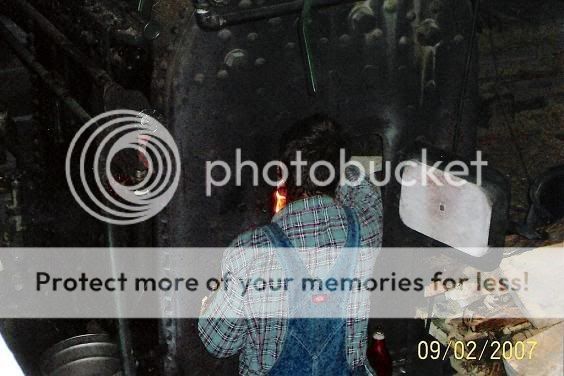
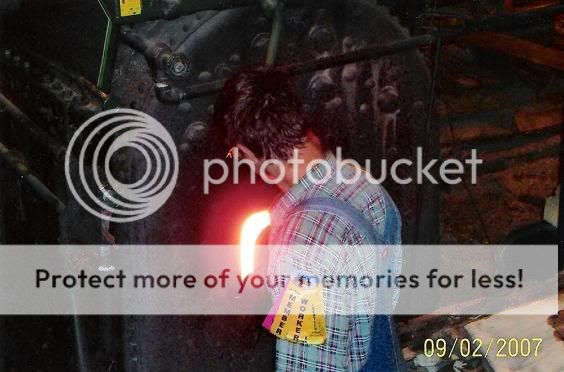
First lighting the fire.
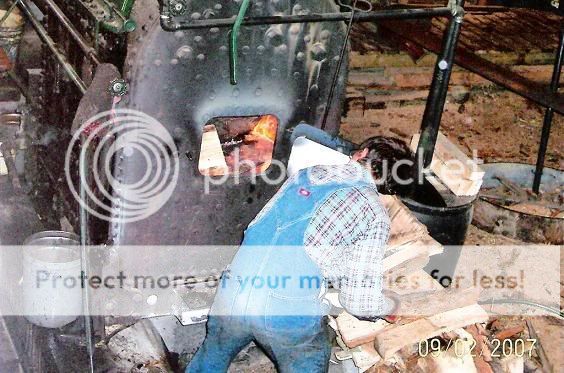
Stoking the fire with as much wood as the box can handle--A LOT!
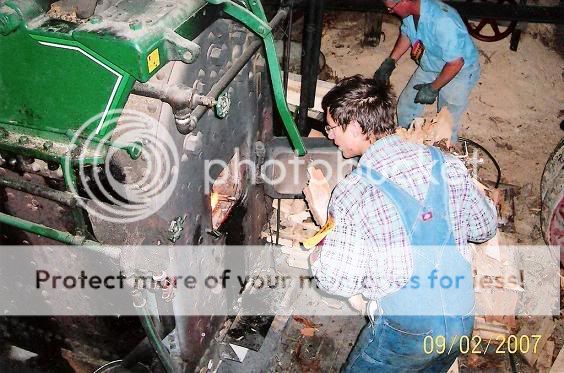
I continued to stoke while Mike gathered up any scraps of wood left over from the previous day's milling.
Once the entire firebox floor, the grates, is covered by a thick layer of wood and flames, it is important to keep the firebox door closed as much as possible, otherwise air is not pulled through the fire – just over it. Now that there are flames to light the interior of the firebox, the flues are seen composing the rear wall of the firebox, carrying the flames through the water filled boiler. The flues seem to be pulling the flames into them as a vacuum cleaner would do, and upon closer inspection, the flames never really touch the metal as they dance through the flues; they balance their way down until they deplete themselves. Although a sizable fire is lit deep within the boiler, it will take a little while before the water gains enough heat to boil and produce any pressure. So, that is a great time to round up an oil can of 'steam-cylinder oil' as it is called, since it can handle high temperatures and mixes with water well.
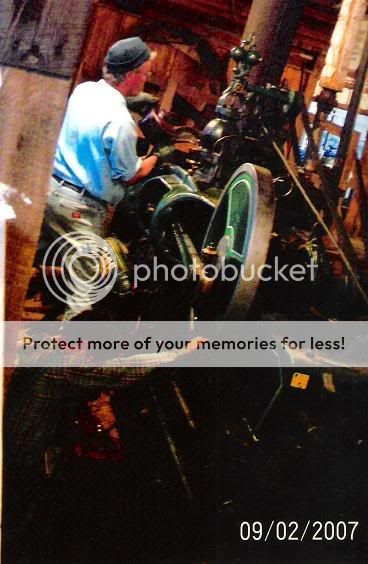
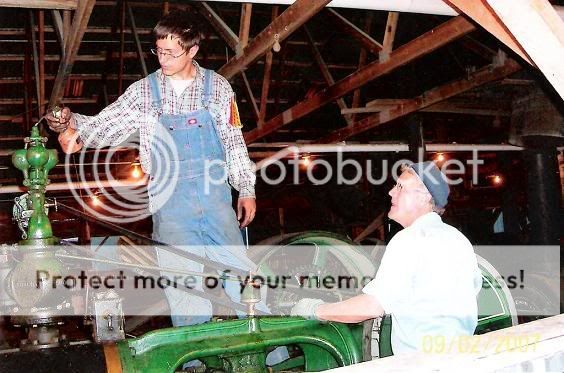
Mike filling the steam oiler as I stood on the ground below, watching.
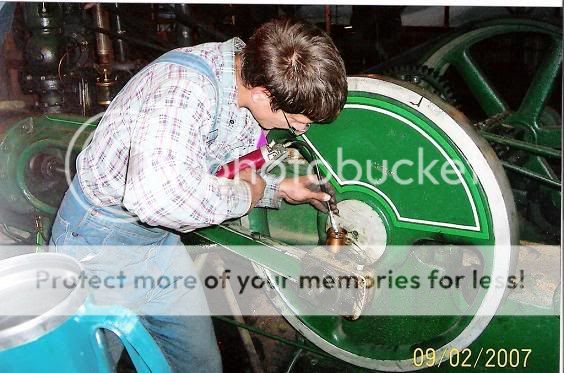
Finding steam oil in an antique sawmill is not very hard to come by, so my next objective was to climb atop the seven foot tall boiler and oil every single contact point on the engine. When given the job of finding every oiler on these engines, it seems easy to be discouraged just by the sheer number of areas that need oil. Eccentric crank, both main bearings, all three metal balls of the governor, the steam oiler, the gear-driven feedwater pump - all these need a good dose of oil several times a day, as prescribed by a steam engineer. The only moving part of the engine that does not need oil is the main crank bearing, or the crankshaft, one might say. Since that is a bearing that gets the most abuse from each push – or pull – of the steam cylinder, it uses a spring loaded grease cup to push grease through the bearing the entire time the engine is running.
Be sure to check out Part Two in the Briden-Roen Sawmill topic--the project was too long for one post!
Here are some pictures to go with the story; for those who have not seen the engine.(I say 'not seen' because it's hard to forget
)
The workday in the steam-powered Briden and Roen Sawmill starts long before the sun comes out to announce the start of its day. Boiler operators like myself trickle into the sawmill under street lamps, anxious to begin another day in the antique sawmill that we call home for the four days of the Western Minnesota Steam Thresher's Reunion. Our foremost task is the cleaning and operating of the horizontal, cylindrical-shaped steam boilers that form the heart and soul of the mill. With boilers, though, cleaning always comes before operating.
The first early morning task for any fireman is to 'punch the flues' as it is called. Inside the both boilers, there are nearly 80 tubes that carry the fire over 15 feet through water before steam drives it out the stubby, partially rusted smoke stack. After a day of firing, each of those flues have a thin, black coat of dusty soot lining them from the firebox to the smoke box. My job was to use an unwieldy, long steel pole; longer than the flues, with a radial-shaped scraper on one end designed to carry all of the soot out to the smoke box.
The smoke box is not exactly a box at all, it is just an empty space where the fire's exhaust changes direction from sideways in the flues, and skyward in the smoke stack. Although most of the leftover soot in the flues is drug into the smoke box, some is left suspended in the air, coating my face and giving the area a distinct, burnt smell. The flue-scraper's handle also gets a gets a reasonable amount of soot on it, which then finds its way to my clothes like a birds to a feeder. Since the boiler was just run the day before, the 1,200 gallons of water covering the flues keeps all of the metal parts at about body temperature, making the flue-scraping a hot, sweaty job. When I had rammed the scraper through all the flues and emptied the smoke box of the black powder, I replaced the old, burnt board that held the smoke box door shut. There is a metal latch meant to do the job of that leaning board, but it had been broken off and lost some time in the last 96 years.
Now that my body had enough soot on it to resemble a walking lump of coal, it was time to make preparations for the fire. The fire grates still carried the leftover, chalky ashes from the previous day, and needed to be swept down in between the rows of slits that let air through to the fire. This makes sure that nothing is stuck in between the metal holding the fire up, otherwise a lack of air will both prevent the hottest fire possible, and keep air from going through the vents in the grates to cool them as it feeds the fire's insatiable appetite for oxygen. If the grates don't get the cooling they need, they heat up to a cherry-red, melt, and the 400 pounds of superheated cottonwood and coal ends up sitting in the ash pan.
Since the grates are now swept off, the restless task of throwing firewood through the firebox door the size of a school lunch tray begins. Only the driest, seasoned wood is used for the initial heap of wood in the cavernous firebox, big enough for a person to lay down comfortably for seasonal cleaning. The only other fuel used to start the fire, besides dry wood, is enough diesel fuel to run a tractor for the better part of a day. Since diesel fuel will not explode or even light very quickly, all it takes is one match to light the monstrous fire.
Before the fire is even thought about being lit, the water level in the boiler must first be checked. On the left side of the boiler, towards the middle, a strange, alien-looking metal apparatus that is tubular in shape, standing vertically with three valve handles spiraling up one side. The valves are the main way to verify exactly how much water is in the boiler at any given time. That is important to know, because if a boiler runs dry, the metal will overheat, become weak, and eventually cause the entire boiler to explode. I decided I would try my best to avoid that, so I opened the bottom valve. Water dripped out. Then, I opened the second valve, and water dripped out.
Now that I know beyond a doubt that there is enough water in the boiler to begin firing for the day, I reach over to the wall near the boiler and grab a box of ordinary kitchen matches from a shelf. I took one, struck it, and as it flared I threw it right on top of the firewood that had been prepared just for that one match. Just like all other living things, the fire starts out small, fire traversing the peaks of the slab wood mountain on which it was placed. As soon as the wood itself begins to burn without the help of the diesel, I continue the frenzy of stacking as much wood on top of the fire as possible. At this point, though, the fire lacks any real motivation; it is just placidly consuming more firewood than a pickup could comfortably carry at any given time.
First lighting the fire.
Stoking the fire with as much wood as the box can handle--A LOT!
I continued to stoke while Mike gathered up any scraps of wood left over from the previous day's milling.
Once the entire firebox floor, the grates, is covered by a thick layer of wood and flames, it is important to keep the firebox door closed as much as possible, otherwise air is not pulled through the fire – just over it. Now that there are flames to light the interior of the firebox, the flues are seen composing the rear wall of the firebox, carrying the flames through the water filled boiler. The flues seem to be pulling the flames into them as a vacuum cleaner would do, and upon closer inspection, the flames never really touch the metal as they dance through the flues; they balance their way down until they deplete themselves. Although a sizable fire is lit deep within the boiler, it will take a little while before the water gains enough heat to boil and produce any pressure. So, that is a great time to round up an oil can of 'steam-cylinder oil' as it is called, since it can handle high temperatures and mixes with water well.
Mike filling the steam oiler as I stood on the ground below, watching.
Finding steam oil in an antique sawmill is not very hard to come by, so my next objective was to climb atop the seven foot tall boiler and oil every single contact point on the engine. When given the job of finding every oiler on these engines, it seems easy to be discouraged just by the sheer number of areas that need oil. Eccentric crank, both main bearings, all three metal balls of the governor, the steam oiler, the gear-driven feedwater pump - all these need a good dose of oil several times a day, as prescribed by a steam engineer. The only moving part of the engine that does not need oil is the main crank bearing, or the crankshaft, one might say. Since that is a bearing that gets the most abuse from each push – or pull – of the steam cylinder, it uses a spring loaded grease cup to push grease through the bearing the entire time the engine is running.
Be sure to check out Part Two in the Briden-Roen Sawmill topic--the project was too long for one post!