Another one of my projects is to document dairy farming technology through the years.
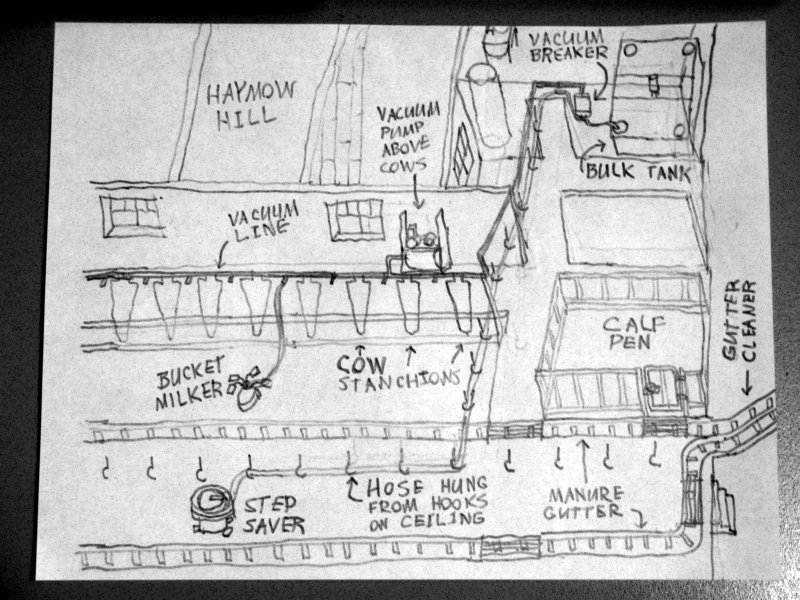
First there were the Surge bucket milkers which hung on a strap over the cow's back, which the farmer had to carry into the milkhouse to dump into a strainer on top of the milk tank.
Then in the 1940's Surge came up with the Step-Saver, which was a little stainless steel cart that rolled down the center barn aisle and had about 150ft of milk hose coiled around it. Rather than walk back to the milkhouse, the farmer steps on a pedal to lift the dust cover on the cart, and dumped the milk into a large funnel. The milk is sucked out the bottom and travels through the 150ft hose on hooks on the ceiling to the glass receiver jar. When the milk has drained out of the cart a big floating ball seals the funnel to maintain system vacuum. As milking progresses the cart is pushed down the aisle and more hose hung from the ceiling on the hooks.
I had an aunt and uncle that (still) used a Surge Step-Saver system up into the early 1980's, but alas their barn burned down so I have nothing I can use locally. I remember as a kid just staying in the milk house and watching that receiver jar repeatedly empty and fill as milking progressed. It was slow but it worked and it saved them a lot of "steps".
I'd like to make some historical pictures and video of a Step-Saver in actual use, along with the old glass-jar receiver / vacuum-breaker that requires no electricity and runs totally off the vacuum system, and the quiet old piston vacuum pumps that run with a gentle "flub-flub" sound. The video would end up on Wikipedia for educational use by anyone around the world.
If there is someone who has one mothballed but which could be reconnected and just needs new hoses, I'd be willing to buy you the 150ft of milkline hose, Surge milker inflations, fresh oil for the old vacuum pump, etc needed to get it back into operation for this documentation project. This way it won't cost you anything other than the time to set it up and show it off for me.
Oh and of course you'll need some cows on the farm to milk with it. Though I suppose I could do a demo of the system in an empty old barn of a retired farmer. I'd have to buy about 10 milk jugs from the store so I have milk to put in the bucket milker for the demo.
Dale Mahalko
Gilman, WI
First there were the Surge bucket milkers which hung on a strap over the cow's back, which the farmer had to carry into the milkhouse to dump into a strainer on top of the milk tank.
Then in the 1940's Surge came up with the Step-Saver, which was a little stainless steel cart that rolled down the center barn aisle and had about 150ft of milk hose coiled around it. Rather than walk back to the milkhouse, the farmer steps on a pedal to lift the dust cover on the cart, and dumped the milk into a large funnel. The milk is sucked out the bottom and travels through the 150ft hose on hooks on the ceiling to the glass receiver jar. When the milk has drained out of the cart a big floating ball seals the funnel to maintain system vacuum. As milking progresses the cart is pushed down the aisle and more hose hung from the ceiling on the hooks.
I had an aunt and uncle that (still) used a Surge Step-Saver system up into the early 1980's, but alas their barn burned down so I have nothing I can use locally. I remember as a kid just staying in the milk house and watching that receiver jar repeatedly empty and fill as milking progressed. It was slow but it worked and it saved them a lot of "steps".
I'd like to make some historical pictures and video of a Step-Saver in actual use, along with the old glass-jar receiver / vacuum-breaker that requires no electricity and runs totally off the vacuum system, and the quiet old piston vacuum pumps that run with a gentle "flub-flub" sound. The video would end up on Wikipedia for educational use by anyone around the world.
If there is someone who has one mothballed but which could be reconnected and just needs new hoses, I'd be willing to buy you the 150ft of milkline hose, Surge milker inflations, fresh oil for the old vacuum pump, etc needed to get it back into operation for this documentation project. This way it won't cost you anything other than the time to set it up and show it off for me.
Oh and of course you'll need some cows on the farm to milk with it. Though I suppose I could do a demo of the system in an empty old barn of a retired farmer. I'd have to buy about 10 milk jugs from the store so I have milk to put in the bucket milker for the demo.
Dale Mahalko
Gilman, WI